

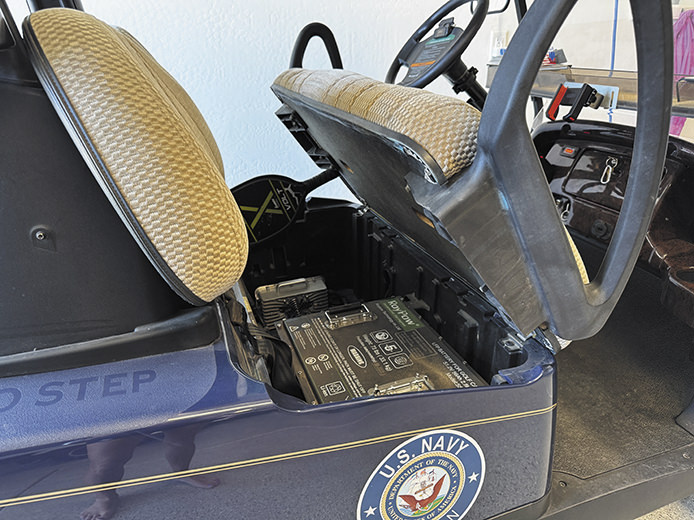
Prop open the golf cart seat while the
battery charges.
Conversions By Doug (ConversionsByDoug@gmail.com)
If you charge your golf cart in the garage, there’s one simple habit that can improve safety, extend battery life, and help you catch problems early: raise the seat while it charges. It may sound like something your grandmother would say, but the science backs it up. And keeping the seat open is easy—many residents use a small stick, scrap of wood, or even an old pickleball paddle to prop the seat up and allow air to circulate.
For carts powered by lead acid batteries, charging produces hydrogen gas, a colorless, odorless, highly flammable byproduct. According to the U.S. Department of Energy, hydrogen becomes explosive at concentrations as low as 4% in air. When a golf cart charges in a closed garage, that gas can accumulate under the seat or in the battery compartment. Propping the seat open allows hydrogen to disperse instead of pooling, reducing the risk of ignition from everyday sources like switches, garage door openers, or static discharge.
For lithium powered carts, the concern shifts from gas to heat. Lithium golf cart batteries are almost always LiFePO4, a chemistry known for stability and long cycle life. Their onboard chargers and battery management systems generate heat during charging. Raising the seat helps that heat escape, reducing thermal stress and extending the life of both the charger and the battery pack.
Keeping the seat open also encourages something many owners rarely do: actually looking at the batteries. A quick glance during each charge can reveal corrosion, swelling, loose cables, or leaks long before they become expensive or dangerous. One important thing to watch for with lead acid batteries: on lead acid batteries you should never see liquid coming out of the vent caps during charging. If electrolyte is bubbling out, the batteries were likely overfilled. Lead acid batteries should only be topped off after they are fully charged, and only to the manufacturer’s recommended level.
Battery experts also emphasize the importance of charging after every use. Lead acid batteries left partially discharged develop sulfation, which permanently reduces capacity. Industry data shows that a lead acid battery cycled to 50% depth of discharge typically lasts around 500 cycles, while shallow cycling to 20–30% can extend life to 1,000 cycles or more. Lithium LiFePO4 batteries, meanwhile, are designed to be charged to 100% after each use, allowing the Battery Management System to balance the cells. These packs often deliver 3,000–5,000 cycles at 80% depth of discharge, far outlasting lead acid systems.
Whether your cart is old school lead acid or modern lithium, the rule is simple: if it’s charging, give it room to breathe.